


Views: 0 Author: Site Editor Publish Time: 2026-06-26 Origin: Site


For many coastal factories, power plants, and remote project sites, the challenge is not access to water but access to usable freshwater at the right quality, volume, and cost. Tanker supply, limited municipal networks, and saline groundwater can all create production risks. An industrial seawater desalination plant offers a more controlled way to secure water for cooling, process use, utilities, or further purification. Before choosing a system, buyers need to understand application fit, SWRO configuration, capacity planning, operating cost, reliability, and brine management.
Industrial buyers usually consider desalination when conventional freshwater sources no longer support daily operation. Municipal water may be unavailable in coastal industrial zones, or the supply may be limited during peak tourism seasons, drought periods, or infrastructure maintenance. Groundwater can also become less useful when salinity rises, wells are overdrawn, or local regulations restrict extraction.
A seawater desalination plant is often selected for water security rather than only for potable water production. Coastal factories, ports, construction camps, offshore utilities, islands, and industrial parks need predictable water availability so production schedules do not depend on tanker deliveries or unstable public networks. The value is not just the water itself; it is the ability to plan operations with fewer supply interruptions.
For factories, stable freshwater can support washing, process preparation, cooling tower makeup, and downstream polishing systems. For ports and offshore locations, it can provide utility water, domestic water, or technical water where local pipelines are difficult to build. A well-planned system gives project owners more control over both quality and supply timing.
Not every industrial project needs the same water standard. A food or beverage facility may need water that meets hygiene and process requirements, while a general manufacturing plant may only need reliable utility water. A coastal power plant may use desalinated water as a pretreatment source before boiler feed polishing, while cooling systems may have a different acceptable quality range.
Final water use should guide the plant design from the beginning. Potable use normally requires post-treatment, remineralization, disinfection, and monitoring. Industrial process water may need lower conductivity, controlled hardness, silica reduction, or additional polishing depending on the equipment it feeds.
Remote coastal sites often care about installation speed and compact layout as much as water quality. Offshore platforms, emergency projects, and temporary camps may prefer equipment that can be transported, installed, and commissioned with less civil construction. KYWATER’s 300T/D containerized RO seawater desalination equipment is positioned for coastal municipalities and industrial applications, making it a useful reference point for this type of buyer.
The intake section brings seawater into the treatment line and removes larger debris before fine treatment begins. Screens, intake pumps, raw-water tanks, and pre-filtration equipment help stabilize the feed before it reaches the RO membranes. The design should account for local seawater movement, debris load, algae risk, sand, and operating access.
Pretreatment is one of the most important parts of an industrial SWRO system because it protects the membranes from fouling, scaling, and damage. Common stages may include multimedia filtration, chemical dosing, antiscalant injection, pH adjustment, dechlorination when needed, and cartridge filtration. Reverse osmosis is widely used for seawater treatment, but pretreatment remains crucial because it protects membrane surfaces and supports system efficiency.
Poor pretreatment usually appears later as unstable flow, higher pressure, more frequent chemical cleaning, shorter membrane life, or inconsistent product water quality. The cheapest design on paper can become expensive if filters clog quickly or membranes need early replacement. For industrial sites, pretreatment should be judged by lifecycle reliability, not only by the number of tanks or filters included.
After pretreatment, the seawater enters the high-pressure RO section. A high-pressure pump drives the feedwater through membrane vessels, where water molecules pass through the membrane and most dissolved salts remain in the concentrate stream. The result is two outputs: freshwater permeate and concentrated brine.
The RO section normally includes membrane vessels, high-pressure pumps, flow meters, pressure gauges, conductivity or TDS monitoring, valves, and a control panel. For medium and larger plants, energy recovery can reduce operating cost by recovering pressure energy from the brine stream. Automation also helps operators monitor pressure, product quality, flow rate, alarms, and shutdown conditions.
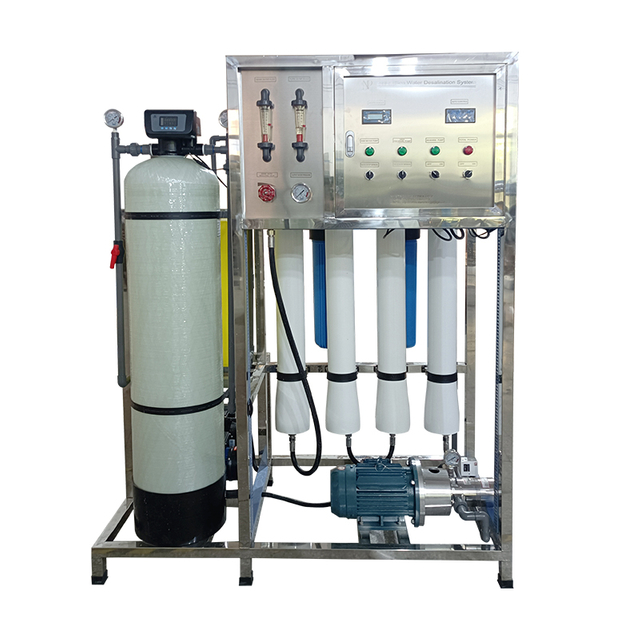
KYWATER’s 300T/D model shows how industrial specifications are commonly presented. The system uses an RO process with an energy recovery system, has a capacity of 300 tons per day, or 12,500 L/H, and is designed for seawater with TDS up to 36,000 mg/L. Those figures help buyers understand that an SWRO plant is not simply a membrane rack; it is a combined process with pressure, monitoring, recovery, and pretreatment requirements.
Sizing begins with demand, not equipment selection. Daily capacity shows how much water the plant can produce in a day, while hourly flow shows whether the system can match real consumption patterns. A site that needs 300 tons per day may still require storage if demand peaks during specific shifts, cleaning cycles, or cooling loads.
Buyers should calculate average demand, peak demand, operating hours, storage capacity, and backup requirements before contacting a supplier. A factory running 24 hours per day may size the system differently from a construction camp with morning and evening peaks. Power plants may also require redundancy because water shortage can affect critical auxiliary systems.
The KYWATER 300T/D configuration converts the daily capacity into 12,500 L/H, which makes the planning more concrete. If a site consumes water unevenly, the hourly flow alone may not be enough, and a treated-water tank may be needed to buffer demand. A realistic sizing discussion should include both production and storage rather than treating nominal output as the whole answer.
A quotation based only on “seawater” is too general for industrial decision-making. Feedwater data should include TDS, salinity, temperature, turbidity, SDI, pH, suspended solids, organics, oil risk, iron, manganese, microbial load, and any seasonal changes. Typical ocean water contains about 35,000 ppm of dissolved salts, but actual local conditions can vary by intake point and environment.
High TDS usually increases operating pressure and can influence membrane selection, recovery rate, and energy consumption. High turbidity or SDI may require stronger pretreatment, while oil contamination near ports can create additional membrane protection needs. Warm water, algae blooms, or organic loading can also change dosing strategy and cleaning intervals.
Without real water analysis, a quotation is only a rough equipment estimate. The final proposal should connect feedwater quality to pretreatment design, pump pressure, membrane array, recovery rate, and maintenance expectations. A serious buyer should prepare laboratory data before comparing prices.
Containerized systems are useful when speed, compactness, and mobility matter. Remote coastal projects, ports, offshore platforms, temporary construction sites, and emergency water supply projects often benefit from equipment installed in a transportable container. This format can reduce site work, protect components, and simplify deployment in locations where building a permanent treatment room is difficult.
Fixed installations are better suited for larger permanent plants or sites with complex civil works. A fixed system can allow larger pretreatment trains, customized access platforms, wider maintenance space, and integration with plant-wide utilities. The tradeoff is usually longer installation time and more dependence on site construction quality.
Option | Best Fit | Main Advantage | Key Limitation |
Containerized system | Remote sites, ports, offshore support, emergency supply | Faster deployment and compact layout | Less flexible for very large custom layouts |
Fixed installation | Large permanent industrial plants | Easier expansion and customized civil design | More site work and longer project schedule |
The cost of a seawater desalination plant is not determined by the RO skid alone. Capacity, feedwater quality, pretreatment configuration, membrane design, pump selection, automation, material selection, installation, commissioning, spare parts, and operator training all affect the final investment. A low equipment price may exclude items that are essential for stable operation.
Energy recovery, corrosion-resistant materials, and stronger pretreatment may raise initial cost but reduce long-term problems. In coastal industrial environments, weaker materials can fail faster because salt air, humidity, and continuous operation create harsh service conditions. A better cost comparison should include expected energy use, consumables, membrane life, cleaning frequency, and service availability.
Project owners should avoid comparing quotations only by capacity. Two systems with the same daily output may have different recovery rates, automation levels, pump brands, membrane layouts, and after-sales support. The more useful question is whether the configuration matches the site conditions and the required water quality.
Reliability matters most after the plant starts operating. Coastal air, salt spray, humidity, high operating pressure, and continuous duty can damage weak components over time. Material selection, pump quality, electrical protection, skid layout, pipework, valves, and control panel protection should all be reviewed.
Automation helps protect the system when conditions change. Useful features include low-pressure protection, high-pressure shutdown, flow monitoring, conductivity or TDS monitoring, alarm history, chemical dosing control, and clear operator interface. Easy access for cartridge replacement, membrane cleaning, pump inspection, and valve maintenance also reduces downtime.
Before comparing two quotations, buyers should ask practical questions:
● What feedwater quality was assumed in the design?
● What pretreatment stages are included before RO?
● What is the rated recovery rate and expected power consumption?
● What materials are used in seawater-contact parts?
● Are commissioning, operator training, spare parts, and cleaning procedures included?
● What alarms and online monitoring functions are provided?
These questions reveal whether a proposal is built for long-term operation or only for a low initial price. A reliable seawater desalination plant should be serviceable by the site team and supported by clear maintenance documentation. The best configuration is not always the most complex one; it is the one that fits the water source, duty cycle, environment, and operator capability.
RO desalination produces freshwater and concentrated brine. The brine stream contains higher salinity than the intake water and may also contain chemical residuals from pretreatment or cleaning. Local concerns often include concentrate discharge, brine dilution, and chemicals used during the treatment process.
A project should define the brine route early because discharge planning can affect layout, permits, pumping, piping, monitoring, and operating cost. Some sites can discharge through a permitted marine outfall with proper dilution. Other locations may need evaporation ponds, blending, reuse, further concentration, or advanced brine treatment.
Leaving this topic until the final design stage creates risk. Even when the RO system itself is technically suitable, the project may be delayed if the brine route is not accepted by local authorities. Early environmental review protects both the buyer and the supplier from redesign work.
A well-prepared inquiry usually receives a better proposal. Instead of asking only for a price per capacity, buyers should provide the information that shapes the system. This helps the supplier recommend a configuration based on real operating needs rather than nominal output.
Key information should include:
● Required daily capacity, hourly flow, operating hours, and backup expectations
● Feedwater analysis, intake source, seasonal risks, and seawater temperature
● Final water use, product-water quality target, and storage requirements
● Site layout, available footprint, power supply, and installation preference
● Brine discharge route, local permit requirements, and environmental constraints
● Preferred automation level, maintenance capacity, commissioning needs, and delivery schedule
This preparation also makes internal decision-making easier. Engineering, procurement, environmental, and operations teams can review the same assumptions before committing to a purchase. A complete inquiry shortens the path from budget discussion to technical proposal.
A reliable seawater desalination plant starts with clear project data: water demand, feedwater quality, final water use, installation conditions, operating cost, and brine discharge route. For factories, power plants, and coastal projects, these details determine whether the system can deliver stable freshwater without creating avoidable maintenance or compliance problems. Guangzhou Kai Yuan Water Treatment Equipment Co., Ltd. provides seawater desalination equipment and related water treatment systems that can support industrial users in turning local seawater into usable process, utility, or supply water with a more controlled operating plan.
A: It removes dissolved salts and impurities from seawater to produce usable freshwater for drinking, process water, cooling systems, utilities, or further purification.
A: Most industrial systems use pretreatment, high-pressure reverse osmosis membranes, post-treatment, and brine handling to convert seawater into controlled freshwater output.
A: Buyers should prepare daily water demand, peak flow, feedwater analysis, final water use, power supply, site layout, operating hours, and brine discharge requirements.
A: Pretreatment removes suspended solids, algae, organics, and scaling risks before seawater reaches the membranes, helping reduce fouling, cleaning frequency, and unplanned downtime.
A: Cost depends on capacity, seawater quality, pretreatment design, membrane configuration, pumps, energy recovery, automation, materials, installation, commissioning, and long-term maintenance needs.
A: Brine is the concentrated saltwater left after freshwater separation. It must be discharged, diluted, reused, evaporated, or further treated according to site conditions and local regulations.


