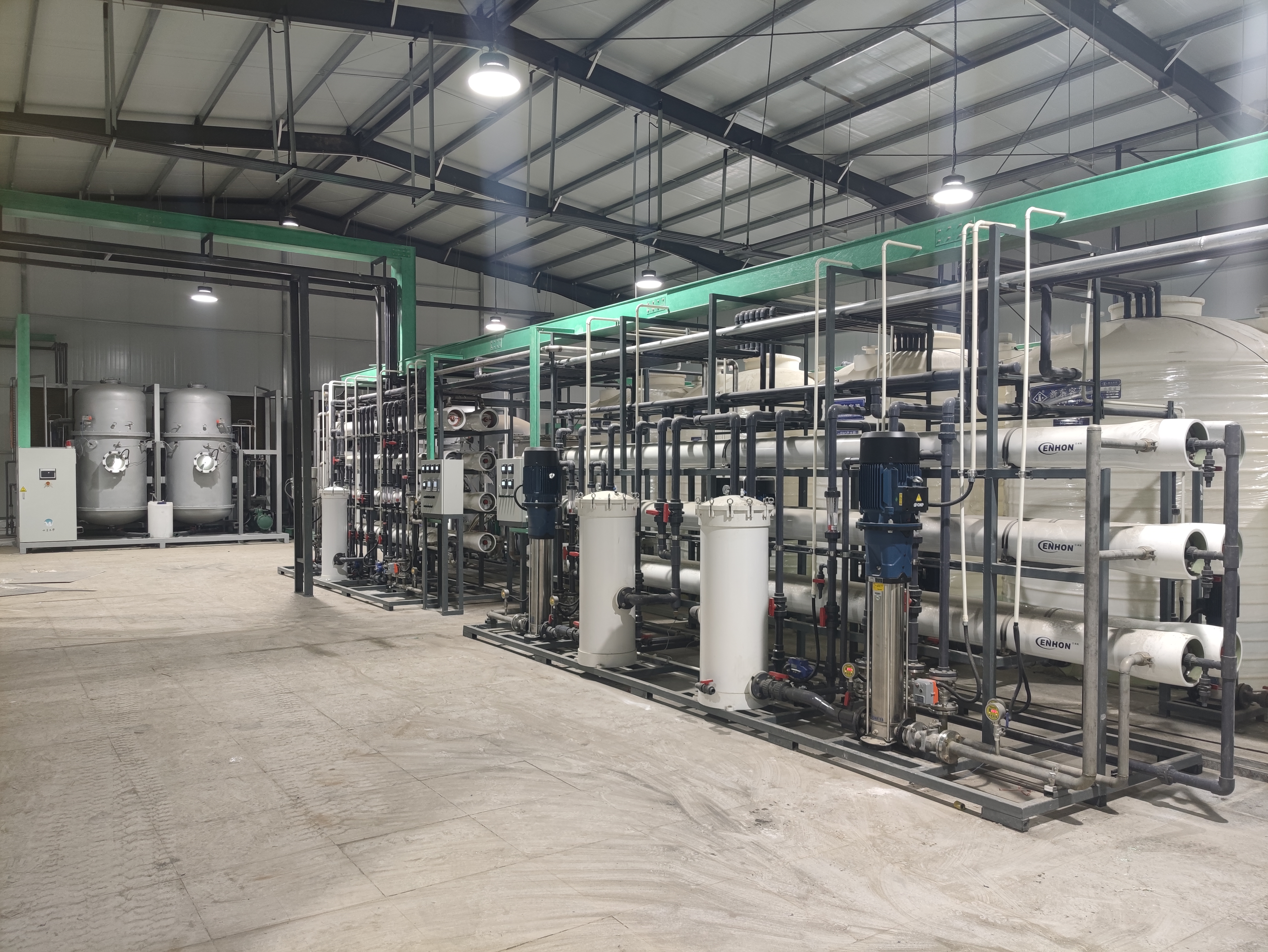
Industrial reclaimed water reuse and zero liquid discharge (ZLD) is a key sector in environmental water treatment. It focuses on recycling high-salinity and high-pollution water such as industrial process wastewater and cooling blowdown. The industry typically adopts a mature process: pretreatment, ultrafiltration, multi-stage RO concentration, and evaporative crystallization. Fiber ball and activated carbon filters remove impurities; ultrafiltration ensures stable RO feed water; three-stage RO progressively concentrates wastewater to reduce volume; evaporation finally achieves zero liquid discharge. Serving high water-consumption industries, this sector helps enterprises save water, reduce discharge, and realize water recycling, which is essential for industrial green development and environmental compliance.
Raw water tank → Booster pump → Fiber ball filter → Activated carbon filter → 5μm security filter → Ultrafiltration (UF) system → Stage 1 RO → Stage 2 RO → Stage 3 RO → Reclaimed water tank → Production reuse

Raw Water Tank + Raw Water Booster Pump
This system collects various types of raw water from the plant area, including production wastewater, circulating cooling wastewater, and washing wastewater, and channels them into the raw water tank for homogenization and regulation.
A level sensor is installed in the tank to automatically control the start and stop of the booster pump, stabilizing the influent flow to subsequent treatment units and preventing fluctuations in water quality and quantity from impacting the system.
In some operating conditions, an aeration and mixing device can be added to prevent suspended solids from settling, ensuring uniform and stable influent flow and providing the foundation for continuous treatment.

Raw Water Pressurization → Fiber Ball Filter
Core Function: Highly efficient removal of silt, rust, suspended solids, colloids, and large particulate impurities from raw water, significantly reducing influent turbidity.
The high porosity and high filtration precision of the fiber ball filter media effectively intercept fine particles, preventing physical clogging and wear of the downstream activated carbon and membrane elements.
The system features automatic backwashing, automatically discharging backwash based on pressure differential or timed intervals to restore filtration efficiency, ensuring long-term stable operation and reducing the load on subsequent treatment processes.
Fiber Ball Permeate → Activated Carbon Filter
Utilizing the porous structure of activated carbon, it adsorbs organic matter, color, odor, residual chlorine, some heavy metal ions, and small molecule pollutants.
Prioritizes the protection of downstream membrane elements: Eliminates the oxidative degradation of ultrafiltration and RO membranes by residual chlorine, extending membrane lifespan.
Further reduces COD and turbidity, improves influent water quality, reduces membrane fouling rate, decreases chemical cleaning frequency, and ensures stable system operation.

Activated Carbon Effluent → Security Filter
As the final physical barrier before the ultrafiltration membrane, it intercepts carbon powder and fine broken particles detached from the activated carbon filter media.
This prevents hard particles from entering the ultrafiltration system, scratching the membrane fibers, and clogging the flow channels, ensuring the cleanliness of the ultrafiltration feed water and improving the operational safety of the membrane system.
Security Filtration Effluent → Ultrafiltration Unit
Utilizes hollow fiber ultrafiltration membranes for high-precision removal of colloids, microorganisms, bacteria, viruses, large organic molecules, and fine suspended particles.
The effluent SDI (Soil Degradation Index) is controlled below 3, fully meeting the stringent feed water requirements of the reverse osmosis system, a key guarantee for stable RO system operation.
Employs a cross-flow filtration mode, combined with regular water backwashing, air-water backwashing, and chemically enhanced backwashing to maintain membrane flux and extend service life.
Ultrafiltration permeate enters the intermediate water tank, while concentrate can be returned to the upstream end for reprocessing, improving overall water utilization.

Ultrafiltration Permeate → High-Pressure Pump → First-Stage RO
Under high pressure, water molecules permeate through the RO membrane. Most dissolved salts, hardness, silica, COD, and heavy metals are retained, achieving initial desalination and concentration.
The first-stage RO permeate is of excellent quality and can be directly discharged into the reclaimed water tank; the concentrated water has a significantly higher salt content and enters the second-stage RO for further concentration, instead of being directly discharged.
This stage completes the initial volume reduction, laying the foundation for subsequent high-concentration.

First-Stage RO Concentrate → Second-Stage RO
This system performs secondary concentration of the first-stage concentrate to further improve recovery rate, reduce concentrate discharge, and enhance overall concentration performance.
The second-stage RO permeate still meets reuse standards and is returned to the permeate system; the concentrate, with continued salt enrichment, enters the third-stage RO for final deep concentration.
Through step-by-step pressurization and optimized membrane configuration, this system adapts to high-salinity feed water, preventing membrane scaling and fouling.
Two-Stage RO Concentrate → Three-Stage RO: This system performs final concentration of high-salt concentrate, achieving a total concentration ratio of 9 times and minimizing the throughput of the evaporation unit.
All permeate from the three-stage RO system is recycled, with only a small amount of high-salt, high-concentration wastewater remaining before entering the evaporation unit.
Using anti-fouling, high-desalination-rate RO membrane elements, along with scale inhibitors and reducing agents, ensures stable operation under high-salt conditions.

Three-stage RO final concentrate → Evaporation System
The concentrate is fed into an MVR evaporator or multi-effect evaporator, where heating causes the water to vaporize. Salts are concentrated to supersaturation and then crystallize out.
The steam is condensed to form high-quality distilled water, which can be recycled back to the system's upstream end or reused in production. The crystallized salts are dried and disposed of in compliance with regulations.
The entire process involves zero wastewater discharge, truly achieving zero liquid discharge (ZLD) for industrial wastewater and meeting environmental protection requirements.