


Views: 0 Author: Site Editor Publish Time: 2026-06-22 Origin: Site


Seawater is easy to access in coastal and marine projects, but turning it into usable fresh water is not as simple as running it through a standard filter. Ocean water contains about 35,000 ppm of salt, which is far beyond what ordinary filtration can remove. A seawater desalination plant solves this by combining intake, pretreatment, high-pressure reverse osmosis, post-treatment, and brine handling into one complete process. For buyers, operators, and project planners, the real value is understanding how SWRO works, what affects performance, and which system details matter before choosing equipment.
A reliable seawater desalination plant starts before the RO membrane. The first step is collecting seawater and bringing it into the system in a controlled way. Open seawater may carry sand, shells, floating debris, algae, suspended solids, and seasonal organic matter. Near harbors, fish farms, or industrial zones, the feed source may also contain oil traces or other contaminants that require additional attention.
That is why feedwater assessment matters. Salinity affects operating pressure, while turbidity and suspended solids influence filter size and pretreatment design. Temperature can change membrane performance, and biological activity can increase fouling risk. A supplier may ask for a water analysis report because two sites with the same required capacity can need different process designs.
Pretreatment is the protection stage for the whole seawater desalination plant. Its job is not simply to make the water look clearer; it must reduce the load on the RO membranes. A typical compact SWRO system may include a raw water pump, sand or multimedia filter, cartridge or security filter, antiscalant dosing, and dechlorination when chlorine has been used upstream. Difficult seawater may require stronger filtration before the high-pressure section.
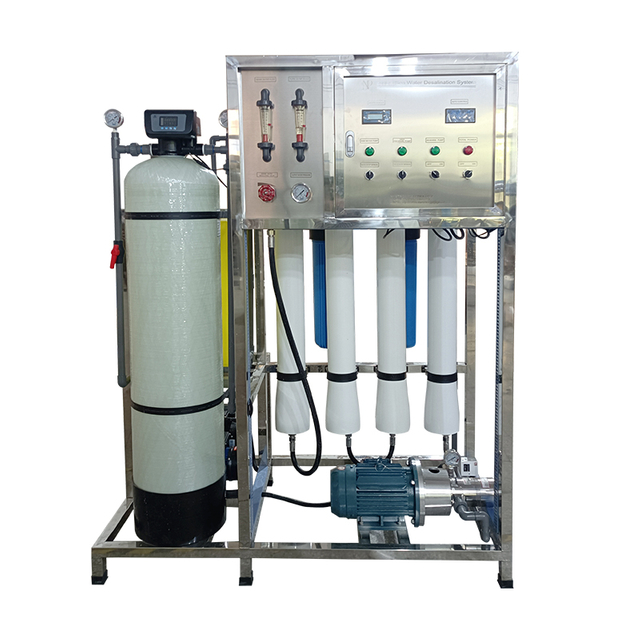
Weak pretreatment often creates problems later. Fouled membranes lose production capacity, require more frequent cleaning, and may consume more energy because the system needs higher pressure to maintain output. Poor upstream protection can also shorten membrane life and make the plant less predictable for operators. KAI YUAN’s 500 LPH model combines integrated pretreatment, automatic flushing, online flow and pressure monitoring, and safety protection functions within the system package.
After pretreatment, the SWRO process reaches its core separation stage. A high-pressure pump pushes pretreated seawater through RO membrane elements. Water molecules pass through the semi-permeable membrane, while most dissolved salts remain on the concentrate side. The result is two streams: product water, also called permeate, and concentrated brine, also called reject water.
This stage is where design discipline matters. Feed TDS, operating pressure, membrane loading, recovery rate, pump efficiency, and water temperature all influence how stable the system will be. Higher recovery may reduce the amount of intake water needed, but it can also increase scaling risk if the design is pushed too far. A seawater desalination plant should balance output, membrane safety, energy use, and maintenance expectations rather than chase one number alone.
Permeate from RO membranes is not always ready for final use. Drinking water projects often need pH adjustment, remineralization, UV sterilization, or other disinfection before the water enters a storage tank or distribution line. Water with very low mineral content may taste flat or become more corrosive, so conditioning helps make it safer and more acceptable for daily use.
Industrial applications can require a different post-treatment route. Some facilities may use SWRO permeate directly for service water, while others may add second-pass RO, EDI, or polishing systems to meet stricter process requirements. Boiler feed pretreatment, electronics manufacturing, and high-purity process water cannot be judged by low TDS alone. The complete process can be summarized as: Seawater Intake → Pretreatment → High-Pressure Pump → RO Membranes → Post-Treatment → Product Water + Brine.
A seawater desalination plant is a chain of equipment working toward one result: stable freshwater production from a difficult source. The intake or raw water pump brings seawater into the system, while pretreatment filters remove particles before they reach sensitive membrane surfaces. Chemical dosing helps control scaling or oxidation risk, and the cartridge filter provides final protection before the high-pressure pump. Each part has a practical role, so removing a stage to reduce price can create higher costs later.
The RO section includes the high-pressure pump, membrane elements, and pressure vessels. These parts create the separation that removes salts from seawater and produces permeate. A control cabinet monitors operation, triggers alarms, and helps protect pumps and membranes from unsafe conditions. Post-treatment equipment then adjusts water quality for drinking, utility, or industrial use.
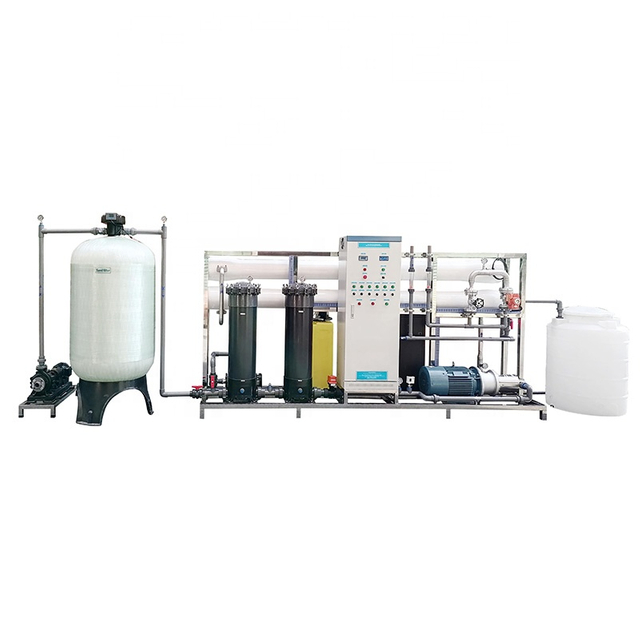
KAI YUAN’s 1000 LPH system illustrates how these components are combined in a compact package. Its standard configuration includes a raw water pump, sand filter, 5μm security filter, high-pressure anti-corrosion pump, RO membrane elements with pressure vessels, PC program control system, UV sterilizer, membrane cleaning tank, and corrosion-resistant piping. This kind of configuration shows why a seawater desalination plant should be evaluated as a system, not as a single membrane unit.
Seawater is aggressive toward unsuitable materials. Pumps, valves, frames, fasteners, piping, and fittings can degrade quickly when exposed to saltwater and humid coastal air. For marine and offshore environments, corrosion resistance is not a premium feature; it is part of basic reliability. Poor material selection may lead to leakage, rust, downtime, and higher replacement costs.
Automation also affects long-term operation. Pressure protection, fault alarms, automatic flushing, conductivity monitoring, and flow monitoring help operators detect problems before they become failures. On vessels, islands, and remote coastal sites, trained staff may not always be available, so clear controls reduce daily operating risk. The 1000 LPH marine system is built with a compact automated structure, real-time monitoring, fault alarms, and automatic membrane flushing for limited-space marine and coastal applications.
A seawater desalination plant is especially useful where freshwater access is limited but seawater is nearby. Marine vessels, fishing boats, offshore platforms, island communities, and remote coastal facilities often face space, supply, and logistics constraints. Transported freshwater can be expensive, weather-dependent, and difficult to store safely for long periods. Producing water on site reduces dependence on outside delivery.
Compact SWRO systems fit these environments because they can combine filtration, high-pressure RO, controls, flushing, and disinfection in a smaller footprint. Operators still need to maintain filters and monitor water quality, but automated functions can lower the daily workload. For marine vessels and offshore facilities, corrosion-resistant construction and stable operation are especially important. KAI YUAN’s 1000 LPH model is positioned for marine vessels, fishing boats, offshore work platforms, islands, remote coastal areas, resorts, and coastal industrial facilities.
Commercial and industrial users often need reliable water for more than drinking. Resorts and hotels may require guest water, laundry water, kitchen support, and service water. Coastal factories may need process water, cleaning water, cooling support, or pretreatment water before a higher-purity system. Some inland locations with high-salinity groundwater may also use similar RO principles, although seawater systems are generally designed for higher salinity and pressure.
Final water quality should be matched to the application. Drinking water needs disinfection, taste adjustment, pH balance, and safe storage. Industrial water may need consistent TDS, low hardness, or further polishing. Boiler, electronics, and high-purity uses normally require additional treatment beyond basic SWRO permeate.
Use Case | Main Need | Design Focus |
Vessel or workboat | Potable water in limited space | Compact layout, corrosion resistance, automation |
Island or remote coast | Daily freshwater supply | Stable operation, storage, simple maintenance |
Resort or hotel | Guest and service water | Post-treatment, taste, disinfection |
Coastal factory | Process or utility water | Capacity, water quality target, operating cost |
Compact capacity works best when the daily demand is clear and the installation conditions are realistic. A 500 LPH unit can support smaller decentralized water needs when demand is moderate and storage is planned well. A 1000 LPH system can suit higher daily demand or more continuous marine and coastal operation. Neither option is automatically better; the right choice depends on demand, runtime, feedwater salinity, power availability, and the required final water quality.
A buyer should calculate daily water use before looking at equipment size. Operating hours matter because eight hours and twenty hours of runtime produce very different daily volumes. Storage tanks can help cover peak demand without oversizing the entire system. A compact seawater desalination plant is enough when capacity, feedwater conditions, power supply, and maintenance access all match the real project.
Pump power, daily running hours, feedwater salinity, pretreatment requirements, chemical consumption, filter replacement, membrane cleaning, labor, and monitoring all affect the real cost of operation. A system with a lower initial price may cost more over time if it uses inefficient pumps, weak pretreatment, or unsuitable materials.
Power should be checked early. The 500 LPH and 1000 LPH KAI YUAN examples use different rated power values, which means the buyer should confirm available voltage, phase, frequency, and expected operating schedule before ordering. Feedwater quality also changes cost because difficult seawater may need more filtration, more chemical control, or more frequent cleaning. A well-designed seawater desalination plant should reduce avoidable maintenance rather than simply produce an attractive quote.
Maintenance is mostly about keeping water quality stable before and after the RO membranes. Operators should watch filter pressure difference, cartridge filter condition, conductivity readings, flow trends, pressure trends, membrane flushing status, chemical dosing levels, and pump vibration. These signals show whether the system is operating normally or moving toward fouling, scaling, or mechanical trouble. Small changes are easier to correct when they are detected early.
Membrane life depends heavily on pretreatment and operating discipline. With proper pretreatment maintenance and regular cleaning, RO membranes in a compact SWRO system may last two to five years, although real service life varies by site. That range should not be treated as a fixed promise for every project, because seawater quality, runtime, cleaning timing, and operator practice all matter. Before purchasing, buyers should request a maintenance schedule, spare parts list, cleaning instructions, and alarm explanation.
Brine is the concentrated stream that carries rejected salts and dissolved compounds away from the RO membranes. It is not the only possible discharge from a seawater desalination plant. Desalination plant discharges may also include pretreatment filter backwash water, SWRO membrane rinsing water, and treated membrane cleaning water, while concentrate itself contains compounds rejected by the RO membranes. This is why discharge planning should be site-specific rather than added after equipment selection.
A practical project should answer several questions before installation:
● Can the brine be discharged locally, and under what conditions?
● Is dilution, monitoring, or further treatment required?
● Where will filter backwash, rinsing water, or cleaning waste go?
● Are environmental approvals needed before operation?
● Does the chosen site have enough drainage and access for maintenance?
Brine handling affects feasibility, not only environmental reporting. A site with no clear discharge route may require a different layout, lower recovery, extra tanks, or further treatment. Local rules may also define monitoring, dilution, or disposal requirements. For that reason, a seawater desalination plant should be planned from intake to discharge, not only from pump to product water.
A seawater desalination plant is most useful when it is planned as a complete process, not just an RO unit. Feedwater quality, pretreatment, pressure control, post-treatment, maintenance access, and brine discharge all shape whether the system can produce stable fresh water over time. For buyers, understanding these details helps avoid under-sized equipment, weak membrane protection, and unexpected operating costs.
Guangzhou Kai Yuan Water Treatment Equipment Co., Ltd. provides SWRO systems for marine, coastal, island, commercial, and industrial water supply needs. Its seawater desalination equipment helps turn local seawater into usable water with integrated filtration, reverse osmosis, automation, and post-treatment options, giving projects a more practical way to reduce dependence on transported or limited freshwater.
A: A seawater desalination plant removes dissolved salts and impurities from seawater so the output can be used for drinking, utility water, or industrial applications.
A: SWRO uses pressure to push pretreated seawater through semi-permeable membranes, allowing water molecules to pass while rejecting most salts and producing a brine stream.
A: Yes, when the system includes proper pretreatment, RO separation, post-treatment, disinfection, and water quality monitoring to meet local drinking water standards.
A: Seawater has higher TDS, so RO systems need greater pressure and more energy, which usually increases operating cost compared with brackish water desalination.
A: Brine is the concentrated salt stream left after RO separation. It must be diluted, discharged, or treated according to site conditions and environmental requirements.
A: Buyers should confirm capacity, feedwater quality, product water use, pretreatment needs, power supply, installation space, maintenance access, and brine discharge planning.


