
Reverse osmosis seawater desalination equipment is a complete water treatment system that converts high-salinity seawater into usable freshwater by membrane separation technology. It is currently a cost-effective and well-proven water supply solution for water shortage scenarios in marine environments. The whole system consists of pretreatment module, high-pressure RO host, automatic dosing unit, online water quality monitoring module and PLC automatic control system. It is specially designed to cope with the characteristics of seawater: high salinity, strong corrosion and complex impurities. Seawater contains large amounts of dissolved salts, suspended sediment, planktonic algae and colloids. These contaminants can easily damage the core membrane elements. Therefore, pretreatment serves as the primary protective barrier to continuously reduce the SDI value and create stable inlet conditions for RO membranes.
The system adopts seawater-specific RO membrane elements, matched with anti-corrosion high-pressure pipelines and high-pressure pump bodies. Salt-water separation is realized under controlled operating pressure. Water molecules pass through the membrane layer to form freshwater, while most soluble salts, heavy metals and microorganisms are trapped and discharged as brine. We provide skid-mounted integrated type, container mobile type and large modular split type according to site conditions. Daily capacity ranges from several tons to thousands of tons to meet different water consumption demands. The system features high automation with auto start-stop, timed flushing, fault alarm and recirculation for off-spec water, which greatly cuts manual work. Wetted components are made of 316L stainless steel or duplex steel to resist corrosion under high salt fog and humid marine conditions for long-term stable running.
The produced freshwater can be used for drinking, domestic water on vessels, industrial make-up water and aquaculture water adjustment. If higher purity is required, secondary RO or EDI polishing can be added after the seawater RO unit. This equipment is widely used on remote islands, offshore drilling platforms, ocean-going working ships, coastal industrial parks and temporary offshore wind camps. Different working conditions have different requirements on shock resistance, noise level, footprint and maintenance. Marine versions are reinforced with shock absorption and anti-tilt structures; containerized units support quick hoisting and deployment; large industrial models are designed for non-stop continuous operation. Kaiyuan Water Treatment focuses on customized seawater and brackish water desalination equipment. With rich project experience, we offer layout planning, manufacturing, factory testing and technical support.
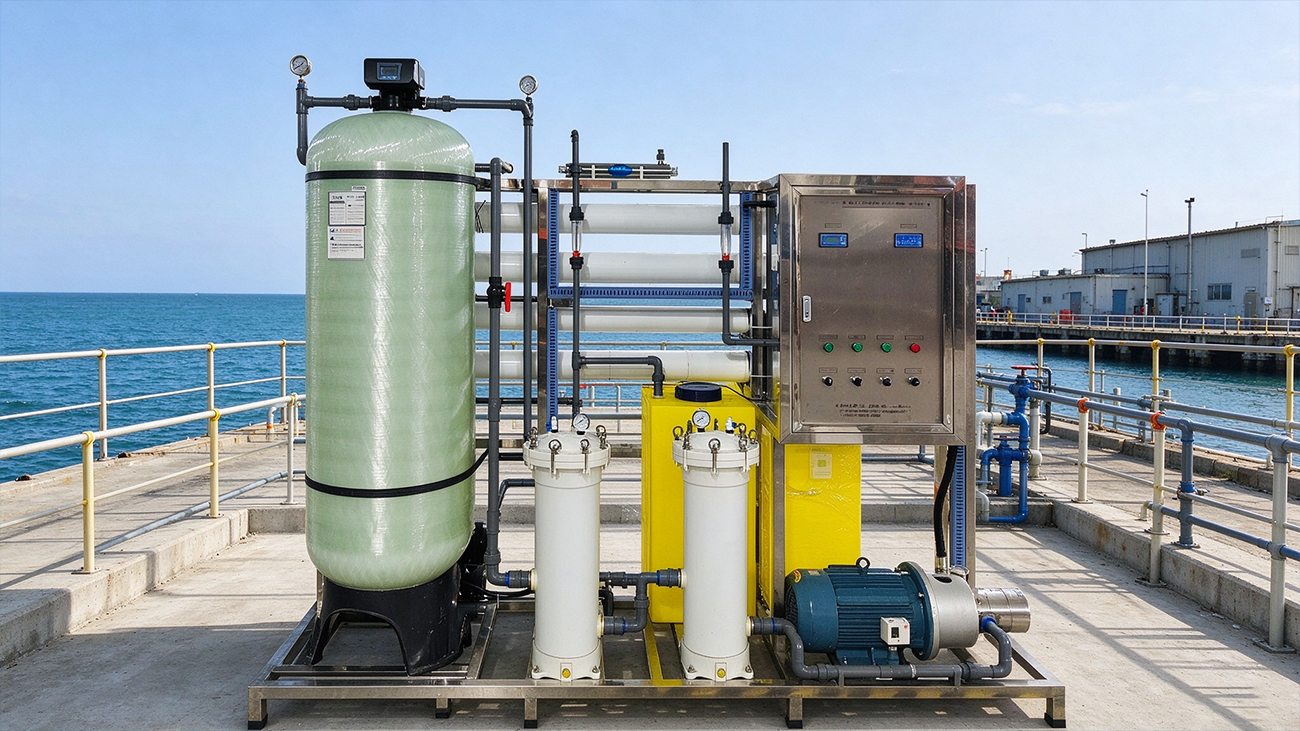
The whole desalination process forms an automatic closed loop from seawater intake to finished freshwater storage. First, the intake pipe extends into seawater, fitted with coarse bar screen at the front to block seaweed, shells, stones and large floating debris, so hard objects will not enter the pipeline and damage pumps. The pre-filtered seawater flows by gravity or submersible pump to the raw seawater tank for buffering and flow balancing. Liquid level sensors inside the tank interlock with downstream pumps to avoid dry running or overflow. Water from raw tank is fed by raw water pump into pretreatment section, which is critical to extend RO membrane service life. Water flows sequentially through multimedia filter and activated carbon filter to remove suspended solids, colloids, odor and part of organic matter. Meanwhile, dosing system adds biocide to suppress algae growth and antiscalant to prevent calcium and magnesium scaling on membrane surface.

After pretreatment, water passes through a 5μm cartridge filter as the final fine guard to trap fine particles and prevent membrane scratching. Qualified pretreated water is delivered to high-pressure seawater pump, which boosts pressure to the rated operating pressure for seawater RO. Pressurized water enters membrane housings loaded with seawater RO elements. Driven by pressure, water molecules permeate the membrane to produce freshwater, while salts and impurities are retained as brine. Brine is discharged in compliance with local environmental regulations; large projects can be equipped with brine recovery devices to improve water utilization. Product water is monitored in real time by online conductivity meter. Once water quality fails standard, the system automatically recirculates the water and triggers alarm to guarantee stable output. Qualified freshwater is sent to clean water tank fitted with breather filter and UV sterilizer to restrain bacterial growth during storage.
The whole process is controlled by PLC cabinet. Auto-flushing program rinses membrane surface with freshwater before and after shutdown to remove attached salt deposits and slow down membrane degradation. A booster pump can be installed after clean water tank to distribute freshwater to all consumption points. The system collects running data including pressure, flow, conductivity and liquid level for local touchscreen display. Remote cloud monitoring is available for large-scale projects. We adjust pretreatment configuration, pump selection and membrane arrangement according to site TDS, water temperature, capacity and power supply to match site conditions and achieve energy-saving, stable and low-maintenance long-term operation.

Containerized large-scale seawater desalination plant

Seawater Desalination Unit

Spec: Daily capacity 5 m³, working pressure 4.0~6.0 MPa, fully automatic control;
Feature: Compact skid-mounted design with small footprint, ideal for small islands and outposts. Pretreatment + RO host integrated, one-touch start, online water quality monitoring included.

Spec: Daily capacity 50 m³, shock-resistant anti-corrosion frame, 2507 wetted parts;
Feature: Adapted to vessel rolling conditions, stable structure with anti-vibration design. Auto-flushing, low noise, product water meets domestic drinking standard for crew, optional UV sterilization module.

Specifications: Daily treatment capacity 24 m³, two-stage reverse osmosis system, 99% desalination rate; Features: Two-stage reverse osmosis system with double-layer filtration, suitable for centralized water supply in coastal factories and schools. Remotely controllable. 24-hour continuous and stable operation, adaptable to high-salinity seawater near the coast.
Learn More
Spec: Daily capacity 100 m³, staged RO process, optional energy recovery device;
Feature: Designed for coastal industrial parks and municipal water supply. Energy optimized, PLC centralized control, support SCADA connection, suitable for year-round non-stop production.

Spec: Integrated inside standard container, daily capacity 50~200 m³, fully pre-tested before delivery;
Feature: Hoistable and movable. Only power and water connection required on site. Perfect for offshore temporary projects and field camps. High protection grade, resistant to high temperature and salt humidity.
Spec: Switchable feed source, compatible with offshore seawater and underground brackish water, daily capacity 10~80 m³;
Feature: One unit for two high-salinity water sources with simple switching. Great for coastal and inland saline land projects, reduces procurement investment.
Open ocean surface seawater generally has TDS between 32000~35000 mg/L, which is the commonly mentioned average salinity of 3.5%. However, seawater salinity is not fixed. It varies by sea area, season, rainfall and river inflow. Near estuaries, freshwater dilution lowers salinity to 10000~25000 mg/L. In enclosed seas with high evaporation, salinity can rise above 40000 mg/L. We prefer site water test reports before design. Different feed salinity changes pump selection, membrane model and pretreatment scheme, which directly affect equipment cost, water yield and long-term stability.
Reverse Osmosis (RO) is the mainstream and proven solution for commercial seawater desalination, also our recommended technology. The system is divided into pretreatment, high-pressure feed section, RO membrane host and post-treatment. Seawater is treated by multi-stage filtration and chemical dosing to remove sediment, colloids, oxidants and organics to reduce fouling risk. Then high-pressure pump pressurizes water to RO operating pressure. Under pressure, water molecules pass through membranes while salts, heavy metals and bacteria are trapped and discharged as brine. Compared with thermal distillation, RO has lower energy consumption, smaller footprint, higher automation and less maintenance. It works well for small marine units and large island water supply projects and is widely selected by overseas buyers.
Seawater RO membrane elements have nominal stable salt rejection ≥99.2%. The overall system rejection normally stays at 98.5%~99%. New systems perform better at first, and rejection will slowly decrease with membrane aging, which is normal. For standard 35000 mg/L seawater feed, product water TDS is usually controlled within 300~500 mg/L, which meets domestic water standard for washing and drinking. If higher purity is required, secondary RO or EDI can be added for polishing to satisfy boiler feed water and precision industrial water requirements. We select the process according to your target water quality.


