


Views: 0 Author: Site Editor Publish Time: 2025-09-11 Origin: Site


Industrial water is the backbone of countless industries, from manufacturing and chemical processing to food and beverage production, pharmaceuticals, power generation, and agriculture. However, raw water sourced from rivers, wells, lakes, or municipal systems is rarely clean enough for direct industrial use. It often contains suspended solids, metallic ions, organic matter, chlorine, microorganisms, and dissolved salts that can harm equipment, compromise product quality, and lead to regulatory non-compliance. The solution lies in industrial water filtration, a carefully designed multi-stage process that removes contaminants step by step, ensuring water safety, consistency, and efficiency.
Industrial water differs significantly from domestic water. In factories, the quality of water directly impacts both equipment performance and product outcomes. Using untreated water can lead to:
Equipment scaling and corrosion: Minerals, salts, and metals deposit inside boilers, cooling towers, or pipelines, reducing efficiency and causing damage.
Product quality issues: In food, beverage, and pharmaceutical industries, contaminants can alter taste, appearance, and safety.
Operational inefficiencies: Suspended solids clog equipment, slowing production and increasing energy use.
Regulatory risks: Industries must meet strict water quality standards. Non-compliance can result in fines, shutdowns, or recalls.
By filtering industrial water properly, companies extend equipment lifespan, improve productivity, and achieve sustainable water management.
The very first stage in industrial water treatment is pre-filtration, an essential step designed to remove visible and suspended impurities before water reaches more advanced systems. Raw water drawn from rivers, lakes, wells, or municipal supplies often carries coarse contaminants such as sand, silt, rust flakes, and organic debris. If not addressed, these particles can scratch pumps, clog valves, and put excessive strain on downstream filters and sensitive equipment.
Multi-layer stacked filters: These advanced polypropylene filters use layers of different densities to trap particles of varying sizes. They are particularly effective at capturing both larger debris and fine suspended matter, ensuring comprehensive sediment removal.
Mesh or screen filters: Simple but reliable, these filters serve as the first line of defense, blocking large objects such as gravel, leaves, or coarse sand particles.
Automatic backwash systems: Unlike traditional filters that require manual cleaning, modern pre-filters can flush themselves automatically. This reduces labor, lowers downtime, and ensures a stable flow of water for continuous operations.
Protects equipment: Prevents clogging and abrasion of pumps, nozzles, and pipelines.
Extends filter life: Reduces the load on finer filters and advanced systems, lowering replacement costs.
Improves process efficiency: Ensures consistent water pressure and flow.
In industries such as textiles, agriculture, paper manufacturing, and basic wastewater treatment, pre-filtration alone can transform raw water into a usable resource, dramatically improving process reliability and reducing operational interruptions.
After removing large sediments, water may still contain invisible yet damaging elements such as iron and manganese ions. These metals are frequently present in groundwater and, if untreated, can wreak havoc on industrial systems. Iron leaves reddish-brown rust stains, while manganese causes black or brown deposits. Over time, these contaminants lead to pipe blockages, fouling of heat exchangers, and deterioration of product quality.
Manganese sand filtration: A proven medium that oxidizes soluble iron and manganese into insoluble forms that can then be filtered out.
Oxidation and aeration processes: Introducing oxygen or oxidizing agents such as chlorine converts dissolved metals into filterable particles.
Multi-media filtration beds: Combining quartz sand, anthracite, and manganese sand creates a layered system capable of handling high concentrations efficiently.
Prevents scaling and corrosion: Protects boilers, cooling towers, and pipelines from mineral buildup.
Improves water clarity and taste: Particularly important in food, beverage, and pharmaceutical industries, where water aesthetics and safety are critical.
Ensures compliance: Meets environmental and industrial regulations regarding heavy metal discharge.
By addressing iron and manganese early, companies reduce maintenance costs, avoid unscheduled downtime, and maintain both equipment integrity and consistent production quality.
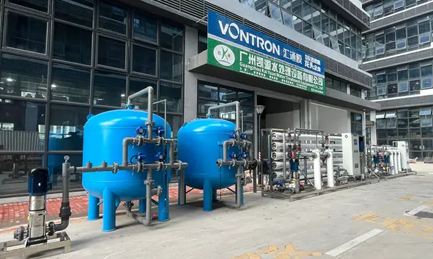
Even after sediment and metal removal, industrial water may still carry chemical contaminants, organic matter, pesticides, and chlorine residues. These substances not only alter water taste and odor but also interfere with sensitive industrial processes. The most effective method for tackling these challenges is activated carbon filtration.
Activated carbon is a highly porous material with an enormous surface area. Through a process called adsorption, molecules of contaminants adhere to the carbon surface, effectively removing them from the water.
Food & beverage production: Eliminates chlorine and organic compounds that negatively affect flavor and aroma.
Pharmaceutical manufacturing: Provides high-purity water for formulations and cleaning processes.
Chemical processing: Reduces unwanted by-products that could compromise chemical reactions.
Wastewater polishing: Serves as a final treatment step to meet discharge or reuse requirements.
Improved water quality: Enhances taste, smell, and safety.
Reduced chemical residues: Protects downstream membranes and resins.
Versatility: Adaptable across multiple industries and water types.
Activated carbon is a cornerstone of industrial water treatment, ensuring that water meets both quality and safety standards before being integrated into production.
After coarse and chemical filtration, water may still contain microscopic particles and colloidal matter invisible to the naked eye. These contaminants, though small, can cause defects in electronics manufacturing, pharmaceutical production, and precision processes. Fine filtration ensures that water achieves a higher level of purity before reaching these critical applications.
Cartridge filters (1–5 microns): These disposable filters capture extremely small particles, serving as the final safety net.
Micron filters with automatic backwash: Designed for continuous operation, these systems automatically flush out collected contaminants, minimizing interruptions.
Compliance with standards: Meets stringent requirements for pharmaceutical and high-tech industries.
Protects advanced systems: Prevents fouling of reverse osmosis membranes and ion-exchange resins.
Ensures consistency: Delivers uniform water quality for sensitive manufacturing processes.
In industries where even a single particle can lead to defective products or costly recalls, fine filtration provides peace of mind and reliability.
For industries requiring the highest levels of water purity, additional processes such as reverse osmosis (RO) and ultraviolet (UV) disinfection are often implemented.
Removes dissolved salts and minerals: Targets sodium, nitrates, sulfates, and other dissolved solids.
Delivers ultra-pure water: Ideal for semiconductor manufacturing, pharmaceuticals, laboratories, and chemical industries.
Prevents scaling and corrosion: Extends the life of high-value equipment.
Neutralizes microorganisms: Uses UV light to deactivate bacteria, viruses, and protozoa without adding chemicals.
Provides eco-friendly sterilization: No chemical by-products or residuals.
Ensures hygienic water: Especially valuable for food processing, healthcare, and bottled water industries.
Together, RO and UV form a robust safeguard, creating the gold standard of industrial water treatment. They not only guarantee compliance with strict purity regulations but also provide industries with the reliability and safety needed for mission-critical operations.
A step-by-step filtration process ensures comprehensive protection and performance. The key benefits include:
Equipment longevity: Reduces scaling and corrosion, extending system lifespan.
Operational efficiency: Maintains stable flow rates, reduces downtime, and optimizes energy use.
Improved product quality: Ensures clean, safe, and compliant production water.
Regulatory compliance: Meets strict water standards across industries.
Cost savings: Lowers maintenance, replacement, and chemical treatment costs.
Sustainability: Many systems recycle water and use energy-efficient designs.
Industrial water filters are adaptable to diverse needs:
Food & Beverage: Clean water is essential for brewing, bottling, and food safety.
Pharmaceuticals: Requires sterile, ultra-pure water for production.
Electronics & Semiconductors: Demands extremely pure water for precision processes.
Textile & Dyeing: Prevents impurities from affecting colors and fabric quality.
Power Generation: Protects boilers and cooling towers from scale and corrosion.
Agriculture & Irrigation: Ensures safe use of groundwater or recycled water.
Each industry benefits from customized filtration systems tailored to its unique challenges.
Filtering industrial water is not a one-size-fits-all process. Each industry, water source, and application requires a tailored multi-stage system. By implementing a structured process that includes pre-filtration, iron and manganese removal, activated carbon treatment, fine filtration, and optional RO/UV purification, industries can achieve reliable, efficient, and sustainable water management.
Guangzhou Kai Yuan Water Treatment Equipment Co., Ltd. specializes in providing complete industrial water filtration solutions. With advanced multi-media systems, energy-efficient designs, and automatic controls, Kai Yuan helps industries protect equipment, ensure compliance, and improve overall efficiency. Whether your business requires basic filtration or ultra-pure water systems, working with a professional partner ensures long-term success and peace of mind.


