


Views: 0 Author: Site Editor Publish Time: 2026-03-11 Origin: Site


A Core Tool Description of Seawater Desalination Equipment for Domestic and Industrial Use in Middle Eastern Countries
Due to the extreme water scarcity, rapidly developing industrial demands, and a continuously growing gap in domestic water supply
in Middle Eastern countries, seawater desalination equipment has transcended the scope of conventional water treatment equipment.
It has become a core infrastructure for ensuring people's livelihoods, an essential production tool for industrial development, and a
necessary support for the socio-economic operation of the region. It is an irreplaceable core piece of equipment adapted to the Middle
East's geography, climate, resource structure, and development needs. The following section clarifies the tool value, adaptability
requirements, and core functions of seawater desalination equipment from two dimensions: domestic and industrial use, combined
with the characteristics of the Middle East.
I. Seawater Desalination Equipment: A Fundamental Tool for Livelihood in the Middle East
Most countries in the Middle East (Saudi Arabia, UAE, Qatar, Kuwait, Oman, etc.) have virtually no freshwater reserves. Surface freshwater is
scarce, groundwater is severely over-extracted and salinized, and natural freshwater cannot meet the basic needs of residents. Seawater
desalination equipment has become the only stable source of drinking water, a necessity for ensuring survival and improving quality of life.

A Core Tool for Residential Drinking Water Supply: With continuous population growth in Middle Eastern countries (e.g., the UAE's annual
population growth rate is approximately 1.5%, Saudi Arabia's is approximately 1.2%), and a high proportion of expatriates (over 80% in Qatar),
the demand for drinking water is increasing year by year. Seawater desalination equipment, through processes such as two-stage reverse
osmosis and multi-effect evaporation, treats high-salinity seawater from the Persian Gulf and Red Sea into freshwater that meets WHO
drinking water standards. This freshwater is then delivered to households through municipal pipelines, solving the core survival problem of "no
freshwater to drink" in the Middle East and providing a fundamental guarantee for residents' daily lives.
Essential Support for Urban Livelihoods: In addition to drinking water, desalinated seawater provides a stable water source for urban greening,
municipal cleaning, and residents' daily needs (laundry, sanitation, cooking), perfectly suited to the high urbanization rates in the Middle East
(Saudi Arabia over 84%, UAE over 89%). Without desalination equipment, essential services in core Middle Eastern cities (Dubai, Riyadh, Doha)
would come to a standstill, directly impacting residents' quality of life and the city's operation.
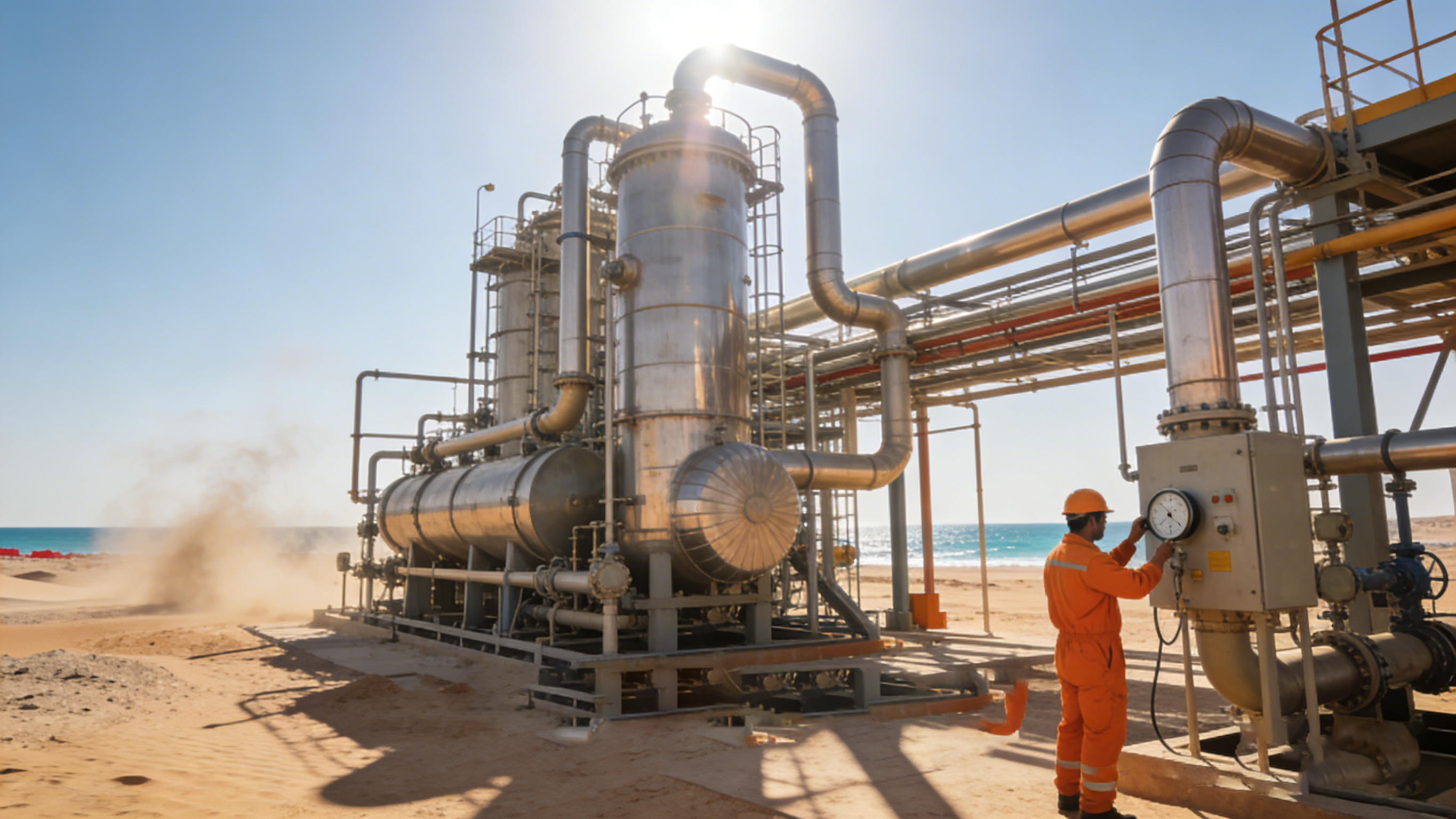
Convenient Tool for Livelihood Coverage in Remote Areas: For small communities, oilfield sites, and island settlements in the heart of the Middle
Eastern desert, small modular desalination equipment (such as a 5T/d two-stage reverse osmosis unit) can achieve on-site water intake and
production due to its small footprint, fully automated operation, and adaptability to high-salinity seawater. This solves the problems of high
freshwater transportation costs and storage difficulties in remote areas, enabling comprehensive coverage of livelihood water supply.


