


Views: 0 Author: Site Editor Publish Time: 2026-08-16 Origin: Site


Investing in seawater reverse osmosis requires significant capital and operational expenditure. Planners often underestimate the hydraulic complexities of this advanced technology. Unfortunately, sizing is never a simple one-to-one match with daily consumption rates. Miscalculating your required capacity quickly leads to premature equipment wear, excessive energy bills, or critical water shortages when you need it most. We see many projects struggle because they base designs on flawed assumptions about average usage rather than peak demands and operational realities.
This article provides an engineering-based framework designed specifically for facility managers, developers, and municipal planners. We will guide you through the variables you must evaluate to accurately specify your system requirements before procurement. You will learn how to calculate true daily demand, account for mandatory downtime, and choose the correct architecture for long-term success.
Optimal sizing requires calculating Peak Daily Demand and factoring in safe operating hours (typically 16–20 hours/day), rather than 24/7 continuous operation.
A reliably sized seawater desalination system for drinking water must account for system recovery rates (usually 35%–45% for seawater) to determine actual feed water intake requirements.
Integrating adequate buffer storage (tanks) is more cost-effective than oversizing the desalination plant to meet transient peak loads.
Redundancy (N+1 architecture) is mandatory for isolated infrastructure like island resorts or off-grid industrial sites.
Engineers must first differentiate between raw water intake, permeate, and brine reject. Permeate is the final product water. Brine is the concentrated waste stream. Raw water intake encompasses the total volume pulled from the ocean. You base your capacity sizing strictly on the required permeate volume.
We segment end-use profiles to establish accurate baselines. Different facilities exhibit entirely different consumption habits. Hospitality projects require nuanced calculations. You must estimate per-capita consumption per guest room. You also need to add volumes for swimming pools, extensive landscaping, and commercial laundry operations. Municipal projects rely on standardized per-capita daily drinking water baselines. Industrial and agricultural applications focus on process-specific volume requirements. They also distinguish between continuous usage and isolated batch usage.
Designing solely for average consumption guarantees failure. Average metrics ignore high-occupancy seasons and sudden transient peaks. If you design a resort system for average winter occupancy, it will fail during the summer peak. You must always calculate the true peak daily demand.
Sector | Primary Usage Variables | Demand Volatility |
|---|---|---|
Hospitality / Resorts | Guest rooms, pools, laundry, landscaping | High (Seasonal peaks) |
Municipal / Community | Per-capita residential usage, public services | Medium (Predictable diurnal curves) |
Industrial / Agricultural | Boiler feed, cooling towers, crop irrigation | Low to High (Depends on batch schedules) |
A Seawater Desalination Plant should never run continuously for 24 hours a day. We design systems to meet your total daily demand within a 16 to 20-hour window. This operating hours variable is critical. You must allocate mandatory downtime for membrane flushing. Preventive maintenance and Clean-in-Place (CIP) cycles also require offline hours. Forcing a system to run nonstop degrades the reverse osmosis membranes rapidly.
Product water storage buffers your hourly peak flow rates. Adequate storage protects the facility from transient spikes. As a rule of thumb, you should size your storage tanks to hold two to three days of average daily demand. Massive tanks are significantly cheaper than oversizing the actual reverse osmosis equipment. Buffer tanks mitigate risks during planned plant downtime or sudden mechanical failures.
You can determine your actual equipment needs using a straightforward calculation framework.
Determine your absolute Peak Daily Water Demand in cubic meters.
Select your target operating window (e.g., 18 hours).
Divide the total daily demand by your target operating hours.
The result is your Required Plant Capacity per hour.
This simple formula ensures you buy enough capacity without wasting capital on unnecessarily large high-pressure pumps.
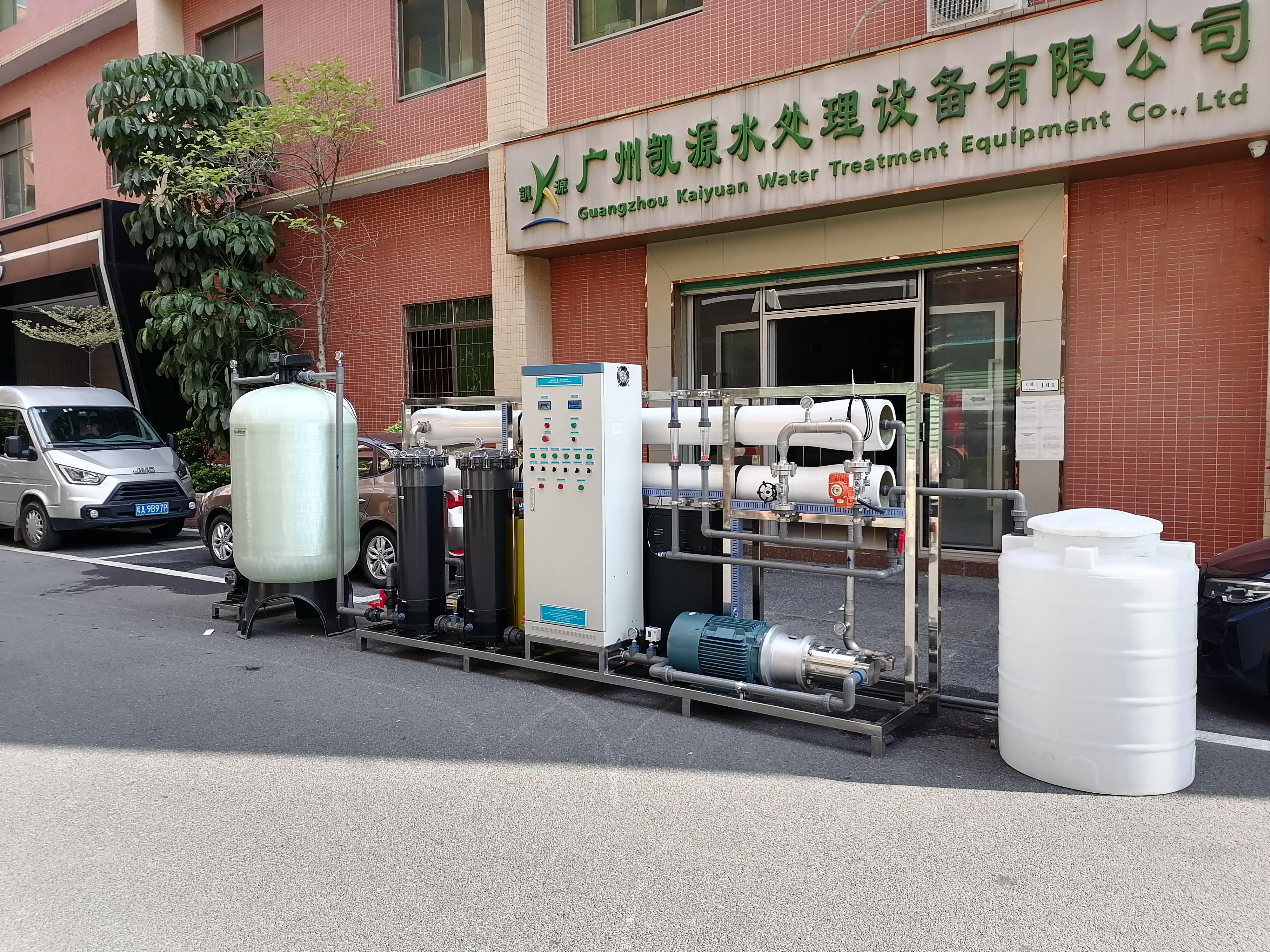
System architecture depends entirely on your calculated hourly capacity. We generally classify equipment into two distinct categories based on daily output.
Skid-mounted and containerized systems serve small to medium demands. These units typically output between 50 and 1,000 cubic meters per day. They are ideal for island resorts and remote coastal communities. Containerized designs offer plug-and-play installation. They drastically lower your civil engineering costs. You avoid pouring massive concrete foundations or constructing dedicated buildings. They also support modular expansion easily.
Custom-engineered facilities handle large municipal or heavy industrial demands. These plants output between 1,000 and 100,000 cubic meters per day. They require permanent civil works. Engineers must design complex intake and outfall marine infrastructure. These large facilities also depend heavily on advanced energy recovery devices (ERDs) to remain economically viable.
When evaluating a Seawater Desalination System for Drinking Water, you must look beyond the basic membranes. Raw reverse osmosis water is highly corrosive and lacks minerals. You need dedicated remineralization modules to make it potable and safe for plumbing. You also need UV sterilization to prevent biological contamination in your storage tanks. Both features impact the overall physical footprint and the electrical power sizing.
Architecture Type | Typical Output Range | Best Application | Key Advantages |
|---|---|---|---|
Skid-Mounted / Containerized | 50 - 1,000 m³/day | Resorts, Remote Islands, Mining Camps | Low civil costs, fast deployment, modular |
Custom-Engineered Facility | 1,000 - 100,000+ m³/day | Municipalities, Heavy Industry | High efficiency, economy of scale, custom ERDs |
Many developers finalize their capacity calculations without considering environmental variables. These hidden factors drastically alter system performance and equipment sizing.
Feed Water Temperature: Seasonal temperature drops reduce membrane flux. Colder water is denser. It moves through membranes slower. You require a larger plant or higher pressure to maintain the same output during winter months.
Feed Water Salinity (TDS): Salinity varies globally. The Red Sea often exceeds 45,000 ppm. The Pacific Ocean hovers around 35,000 ppm. Higher salinity demands larger high-pressure pumps and heavier piping materials.
Energy Availability: You must balance your capacity against available grid power or generator limits. High-capacity systems draw immense startup currents.
Energy Recovery Constraints: Energy Recovery Devices (ERDs) are mandatory for systems producing over 100 cubic meters daily. They capture pressure from the reject brine to assist the main pump.
Redundancy Requirements (N+1 Design): Isolated sites cannot survive single-point failures. You should split capacity across multiple trains. Installing two 50% capacity units is much safer than installing one 100% capacity unit. If one pump fails, you still maintain half your water production.
Sizing errors carry severe financial consequences. Undersizing a facility triggers a cascade of operational failures. Operators inevitably force an undersized plant to run 24 hours a day to meet demand. This continuous operation accelerates membrane fouling. It voids manufacturer warranties. Eventually, it leads to emergency water rationing when the system inevitably breaks down.
Oversizing creates entirely different problems. Buying a massively oversized plant wastes precious capital expenditure. It also creates hydraulic issues downstream. Oversized distribution lines suffer from low flow velocities. Stagnant water creates serious health and compliance risks. Furthermore, massive pumps operating below their optimal efficiency curves waste massive amounts of electrical energy.
You must find the sweet spot. We recommend aligning modular scalability with realistic projected growth plans over five to ten years. Do not buy a plant designed for your 20-year projection on day one. Install the foundational piping now, but add the physical reverse osmosis trains modularly as your population grows.
Do not request a manufacturer quote without conducting a comprehensive feed water analysis first. A raw water test is the mandatory first step of procurement. Vendors cannot size pre-filtration equipment without knowing your Total Suspended Solids (TSS) and Silt Density Index (SDI). They cannot size the high-pressure pump without knowing your exact salinity and seasonal temperature ranges. Blindly requesting a quote leads to generic proposals that will fail in the field.
You must clearly define the scope of supply. Boundary limits often cause disputes during installation. Clarify whether the vendor provides the raw seawater intake pumps. Determine who supplies the pretreatment multimedia filtration. Specify if post-treatment remineralization is included. Some vendors only quote the bare reverse osmosis skid to appear cheaper. You need a complete, integrated system. Defining these boundaries early ensures apples-to-apples bid comparisons.
Accurate sizing requires a delicate balance between hydraulic demand, operational downtime, and adequate buffer storage. You cannot simply match your daily consumption to a plant's 24-hour theoretical capacity. Environmental factors like temperature and salinity heavily influence your final equipment specifications.
Take time to calculate your true peak demand. Plan for 16 to 20 hours of daily operation. Secure comprehensive water analysis reports before engaging vendors. Finally, we strongly encourage consulting an experienced water treatment engineer. They will validate your capacity models before you commit to a specific configuration.
A: Industry standards dictate 16 to 20 hours of daily operation. We do not recommend continuous 24/7 operation. Membranes require routine offline downtime for automated flushing and chemical cleaning. Pushing equipment continuously causes rapid degradation and drastically shortens membrane lifespan.
A: Seawater reverse osmosis typically yields a 35% to 45% recovery rate. This means 100 gallons of raw seawater produces roughly 40 gallons of fresh permeate. The remaining 60 gallons becomes concentrated brine. You must size your intake pumps to handle this full raw water volume.
A: Yes, capacity directly influences energy use. Larger volumes require massive high-pressure pumps. However, systems exceeding 100 cubic meters daily utilize energy recovery devices (ERDs). These devices capture pressure from the reject brine stream. ERDs drastically lower the overall power requirement per cubic meter.
A: We advise against massive oversizing on day one. Instead, you should design the facility for modular expansion. You can install pre-sized piping and electrical infrastructure initially. Then, you simply add independent reverse osmosis trains as your population or production scale increases.


